
Official Payarmin Supplement Facts: Label Transcript, Milligrams & Lab Notes
The full panel from the maker's artwork, transcribed word for word, then read line by line: what each number means, what is missing and what to ask the vendor.
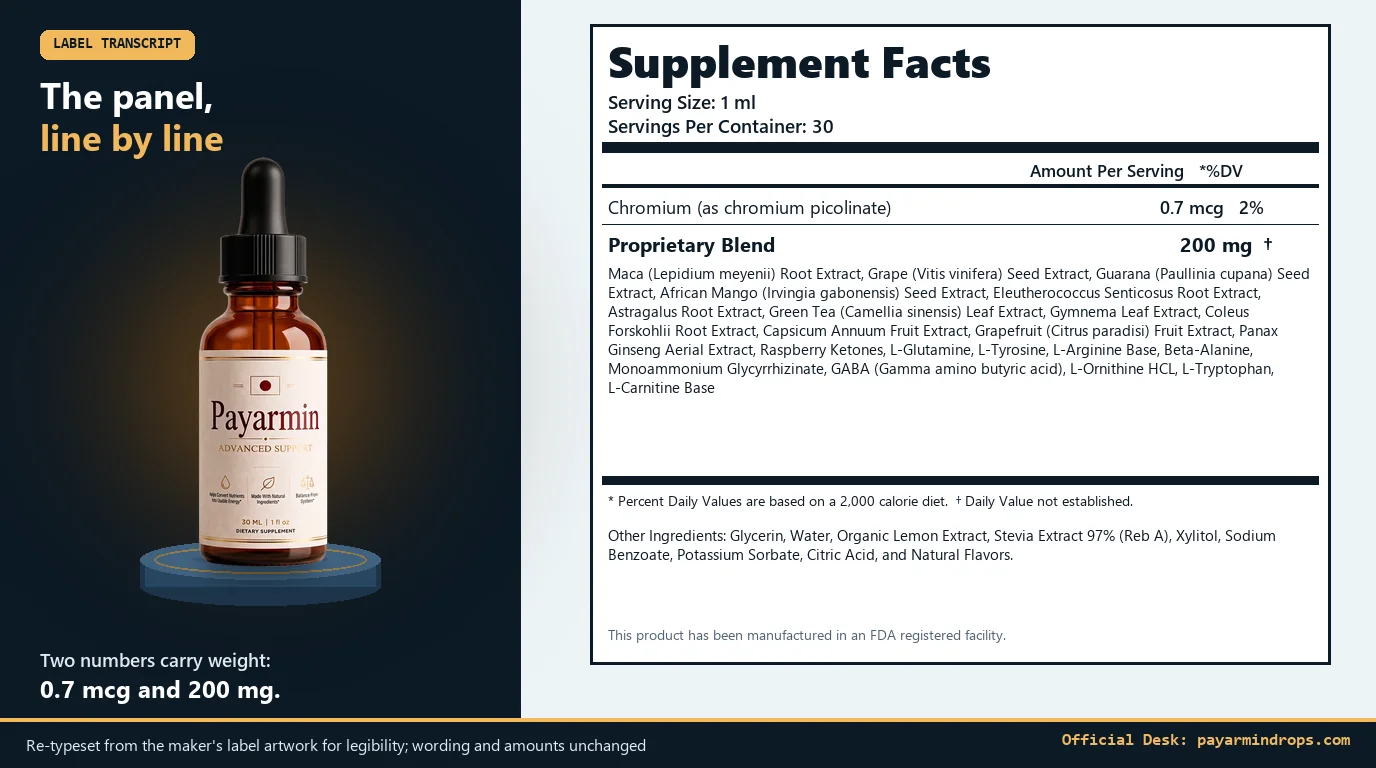
The panel as printed
Below is the maker's own label artwork, followed by a text transcript. Wording, spelling, order and amounts are unchanged; we only re-typed it so it can be read on a phone and by screen readers.
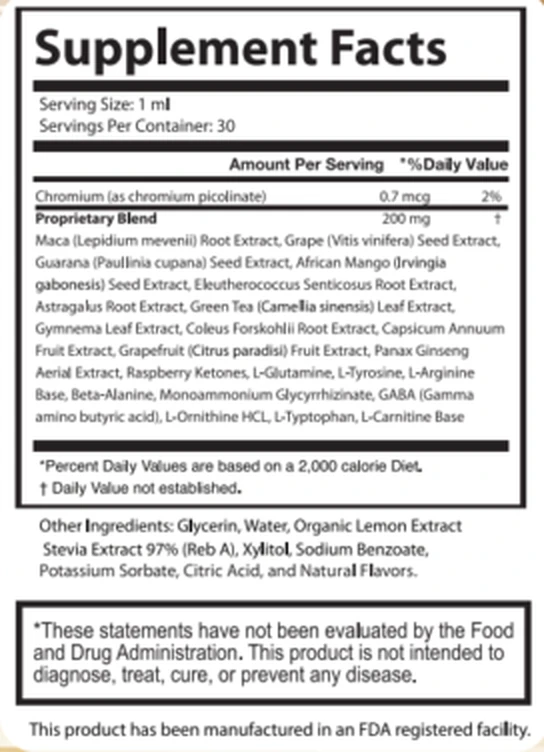
Supplement Facts
Servings Per Container: 30
† Daily Value not established.
Other Ingredients: Glycerin, Water, Organic Lemon Extract, Stevia Extract 97% (Reb A), Xylitol, Sodium Benzoate, Potassium Sorbate, Citric Acid, and Natural Flavors.
*These statements have not been evaluated by the Food and Drug Administration. This product is not intended to diagnose, treat, cure, or prevent any disease.
This product has been manufactured in an FDA registered facility.
Serving size and servings per container
Serving Size: 1 ml. The label's directions say "take 1 or 2 droppers full daily", so one full dropper is meant to equal the 1 mL serving. Glass droppers with rubber bulbs rarely fill exactly; one squeeze typically draws 0.7 to 1 mL depending on how hard you press and how long you wait. Precision is not critical for this product, but consistency is: use the same squeeze each day.
Servings Per Container: 30. The bottle holds 30 mL (1 fl oz). At one dropper a day it lasts about a month; at two, about 15 days. The order page labels each bottle as a 30-day supply, which matches the one-dropper routine. If you plan on two droppers, double the number of bottles you need.
Chromium (as chromium picolinate) 0.7 mcg, 2% DV
This is the only active ingredient with its own amount. The Daily Value for chromium on U.S. labels is 35 mcg, so 0.7 mcg is 2%, which matches the label. Picolinate is one of the best-absorbed chromium forms, but absorption of any form is low, roughly 0.4 to 2.5%[1].
For perspective: chromium supplements sold for glucose usually contain 200 to 1,000 mcg, the range used in trials[4]. A typical U.S. diet already provides more chromium per day than 40 servings of Payarmin would.
Proprietary Blend 200 mg: the 22 entries
U.S. rules allow a supplement to list a group of ingredients under one "proprietary blend" with a total weight, as long as the ingredients appear in descending order by weight[2]. The company does not have to state individual amounts. The "† Daily Value not established" mark is standard for botanicals and amino acids that have no official daily target.
| Order | Blend entry (as printed) | Amount per 1 mL |
|---|---|---|
| 1 | Maca (Lepidium meyenii) Root Extract | Not stated |
| 2 | Grape (Vitis vinifera) Seed Extract | Not stated |
| 3 | Guarana (Paullinia cupana) Seed Extract | Not stated |
| 4 | African Mango (Irvingia gabonensis) Seed Extract | Not stated |
| 5 | Eleutherococcus Senticosus Root Extract | Not stated |
| 6 | Astragalus Root Extract | Not stated |
| 7 | Green Tea (Camellia sinensis) Leaf Extract | Not stated |
| 8 | Gymnema Leaf Extract | Not stated |
| 9 | Coleus Forskohlii Root Extract | Not stated |
| 10 | Capsicum Annuum Fruit Extract | Not stated |
| 11 | Grapefruit (Citrus paradisi) Fruit Extract | Not stated |
| 12 | Panax Ginseng Aerial Extract | Not stated |
| 13 | Raspberry Ketones | Not stated |
| 14 | L-Glutamine | Not stated |
| 15 | L-Tyrosine | Not stated |
| 16 | L-Arginine Base | Not stated |
| 17 | Beta-Alanine | Not stated |
| 18 | Monoammonium Glycyrrhizinate | Not stated |
| 19 | GABA (Gamma amino butyric acid) | Not stated |
| 20 | L-Ornithine HCL | Not stated |
| 21 | L-Tryptophan | Not stated |
| 22 | L-Carnitine Base | Not stated |
What you can infer: maca is the largest share, and everything after it is the same size or smaller. L-carnitine base is the smallest. If the blend were split evenly each entry would be about 9 mg; a realistic descending split might give maca 30 to 50 mg and the last entries 1 to 3 mg. We present that as an illustration, not a fact; only the maker knows.
Other ingredients: what makes up the liquid
- Glycerin: a sweet, viscous solvent that dissolves extracts and gives the liquid body. Minimal effect on blood glucose at 1 to 2 mL.
- Water: the main carrier.
- Organic lemon extract and natural flavors: taste masking for a bitter herbal mix.
- Stevia extract 97% (Reb A): a high-purity steviol glycoside sweetener, essentially calorie-free.
- Xylitol: a sugar alcohol sweetener with a low glycemic effect. Safe for people at this level, dangerous to dogs.
- Sodium benzoate and potassium sorbate: preservatives that keep the opened bottle from growing mold or bacteria.
- Citric acid: adjusts acidity and helps the preservatives work.
No sugar, artificial colors or common allergens are listed, though the label makes no allergen statement either way.
Directions, storage and warnings on the side panel
Suggested use: "Shake well before each use. Take 1 or 2 droppers full daily. Place in mouth and swallow."
Storage: "Keep away from heat, light, and humidity to preserve freshness."
Caution: "Do not exceed recommended dose. Pregnant or nursing mothers, children under the age of 18 and individuals with a known medical condition should consult a physician before using this or any dietary supplement."
Also printed: "Keep out of the reach of children. Do not use if safety seal is damaged or missing. Store in a cool, dry place." And: "Made in the USA with globally sourced ingredients."
What the label does not warn about, and we think should: caffeine content from guarana and green tea[5], xylitol and dogs, the licorice compound and blood pressure[6], and possible interactions with glucose-lowering drugs, warfarin and antidepressants. Our safety page covers each.
The front label claims
The front of the bottle reads "Payarmin, Advanced Support", "30 ML | 1 FL OZ, Dietary Supplement", with three icons: "Helps Convert Nutrients Into Usable Energy*", "Made With Natural Ingredients*" and "Balance Form System*". Each asterisk points to the FDA disclaimer on the facts panel.
"Helps convert nutrients into usable energy" is a classic structure/function phrasing, usually tied to B vitamins; there are no B vitamins on this label. "Balance Form System" is a brand phrase without a defined meaning. None of the front claims mentions blood sugar directly; that message comes from the sales page.
Distributor, origin and facility
The label names "Distributed by: Instituto Experience, Lakeland FL, 33804, +1 (507) 448-8190, [email protected]". A distributor is the company responsible for the product in the market; the actual manufacturer is not named, which is common. The same distributor, phone and email appear on several other supplements sold through the same network.
"This product has been manufactured in an FDA registered facility" means the factory is on the FDA's food facility register. Registration is required for any facility making food or supplements for the U.S. market; it is not an inspection result or an approval. Supplement makers must follow current Good Manufacturing Practice rules, which include identity testing and written specifications for each batch[3].
How to compare this label with other glucose products
When you stand Payarmin next to another blood sugar supplement, three questions sort them quickly.
- How many actives carry their own amount? Payarmin itemizes one (chromium). Labels that print every ingredient in milligrams let you check each against research; a blend total does not.
- Do the itemized amounts reach research doses? For chromium, look for 200 mcg or more; for gymnema, around 400 mg of extract; for Panax ginseng, a gram or more of root. Payarmin's 0.7 mcg chromium does not reach that range, and the rest is unknown.
- What is the serving per day at the maximum? Two droppers give 400 mg of total blend. A single capsule of many single-ingredient products holds 500 mg of one herb.
None of this tells you whether a product will help you personally; that is what a fasting log is for. It does tell you which labels make claims you can check and which ask for trust. Payarmin's label is honest about what it contains; it is simply light on how much.
A last tip: photograph the side panel of any bottle you buy. Formulas change quietly over time, and a dated photo is the easiest way to know what you actually took if you later compare notes with your clinician or file a refund request.
Is there a certificate of analysis?
A certificate of analysis (CoA) is a lab report for a single production lot, typically covering identity, potency of key ingredients, heavy metals (lead, arsenic, cadmium, mercury) and microbial limits. Payarmin's maker does not publish one, and we do not have one. We will not invent lab numbers.
If purity matters to you, and with a botanical liquid it reasonably might, email [email protected] with the lot number printed on your bottle and ask for that lot's CoA. Federal guidance encourages consumers to ask companies for this kind of quality information[7].
Questions on this topic
What is the serving size of Payarmin?
1 mL, which the label equates with one full dropper. You can take 1 or 2 droppers a day. There are 30 servings in each 30 mL bottle.
How much chromium is in Payarmin?
0.7 mcg per 1 mL serving, as chromium picolinate. That is 2% of the Daily Value and a small fraction of the 200 to 1,000 mcg used in studies.
What is in the Payarmin proprietary blend?
22 entries totaling 200 mg per serving: maca, grape seed, guarana, African mango, eleuthero, astragalus, green tea, gymnema, coleus, capsicum, grapefruit, Panax ginseng aerial extract, raspberry ketones, L-glutamine, L-tyrosine, L-arginine, beta-alanine, monoammonium glycyrrhizinate, GABA, L-ornithine, L-tryptophan and L-carnitine.
Does Payarmin contain sugar?
No sugar is listed. It is sweetened with stevia and xylitol, in a glycerin and water base. These barely affect blood glucose at 1 to 2 mL.
Is Payarmin third-party tested?
No third-party test results or certificates of analysis are published. The label states manufacture in an FDA-registered facility. Ask the vendor for your lot's CoA.
Who makes Payarmin?
The label names Instituto Experience of Lakeland, Florida, as distributor; the manufacturer is not named. The checkout signs as Payarmin Research and payment is handled by BuyGoods.
Sources for this page
Each entry links to the original record. The studies tested single ingredients, usually at doses many times larger than a 200 mg blend can hold; none tested the Payarmin dropper itself.
- 1NIH Office of Dietary Supplements. Chromium: Fact Sheet for Health Professionals. ods.od.nih.gov/factsheets/Chromium-HealthProfessional/
- 2U.S. Food and Drug Administration. Questions and Answers on Dietary Supplements. www.fda.gov/food/information-consumers-using-dietary-supplements/questions-and-answers-dietary-supplements
- 3Electronic Code of Federal Regulations. 21 CFR Part 111: Current Good Manufacturing Practice in Manufacturing, Packaging, Labeling, or Holding Operations for Dietary Supplements. www.ecfr.gov/current/title-21/chapter-I/subchapter-B/part-111
- 4Costello RB, Dwyer JT, Bailey RL. Chromium supplements for glycemic control in type 2 diabetes: limited evidence of effectiveness. Nutr Rev. 2016;74(7):455-468. pubmed.ncbi.nlm.nih.gov/27261273/
- 5U.S. Food and Drug Administration. Spilling the Beans: How Much Caffeine Is Too Much? www.fda.gov/consumers/consumer-updates/spilling-beans-how-much-caffeine-too-much
- 6Penninkilampi R, Eslick EM, Eslick GD. The association between consistent licorice ingestion, hypertension and hypokalaemia: a systematic review and meta-analysis. J Hum Hypertens. 2017;31(11):699-707. pubmed.ncbi.nlm.nih.gov/28660884/
- 7National Center for Complementary and Integrative Health. Using Dietary Supplements Wisely. www.nccih.nih.gov/health/using-dietary-supplements-wisely
Ready for a fair 60-day Payarmin routine?
Orders finish on the maker's BuyGoods checkout. Log a week of fasting readings before the first dropper, and if nothing shifts, email the vendor before day 60: opened and empty bottles both qualify for the refund.