
How Payarmin Works: Glucose Pathways, Mechanisms & Trial Evidence
Six pathways the label is aimed at, the dose each would need, and an evidence grade for whether one or two droppers can reach it.
First, how blood sugar is normally regulated
After a meal, carbohydrates are broken down to glucose and absorbed. Blood glucose rises, the pancreas releases insulin, and insulin tells muscle, fat and liver cells to take glucose in or store it. Between meals, the liver releases stored glucose to keep levels steady. In insulin resistance, cells respond less to insulin, so the pancreas has to make more of it to achieve the same effect; when it cannot keep up, fasting and post-meal glucose drift upward, first into the prediabetes range and later into diabetes[1].
Gut hormones join in. GLP-1, released from the intestine after eating, boosts insulin release, slows stomach emptying and signals fullness. Prescription GLP-1 drugs exploit this pathway with molecules that last for days[15]. The body's own GLP-1 lasts minutes.
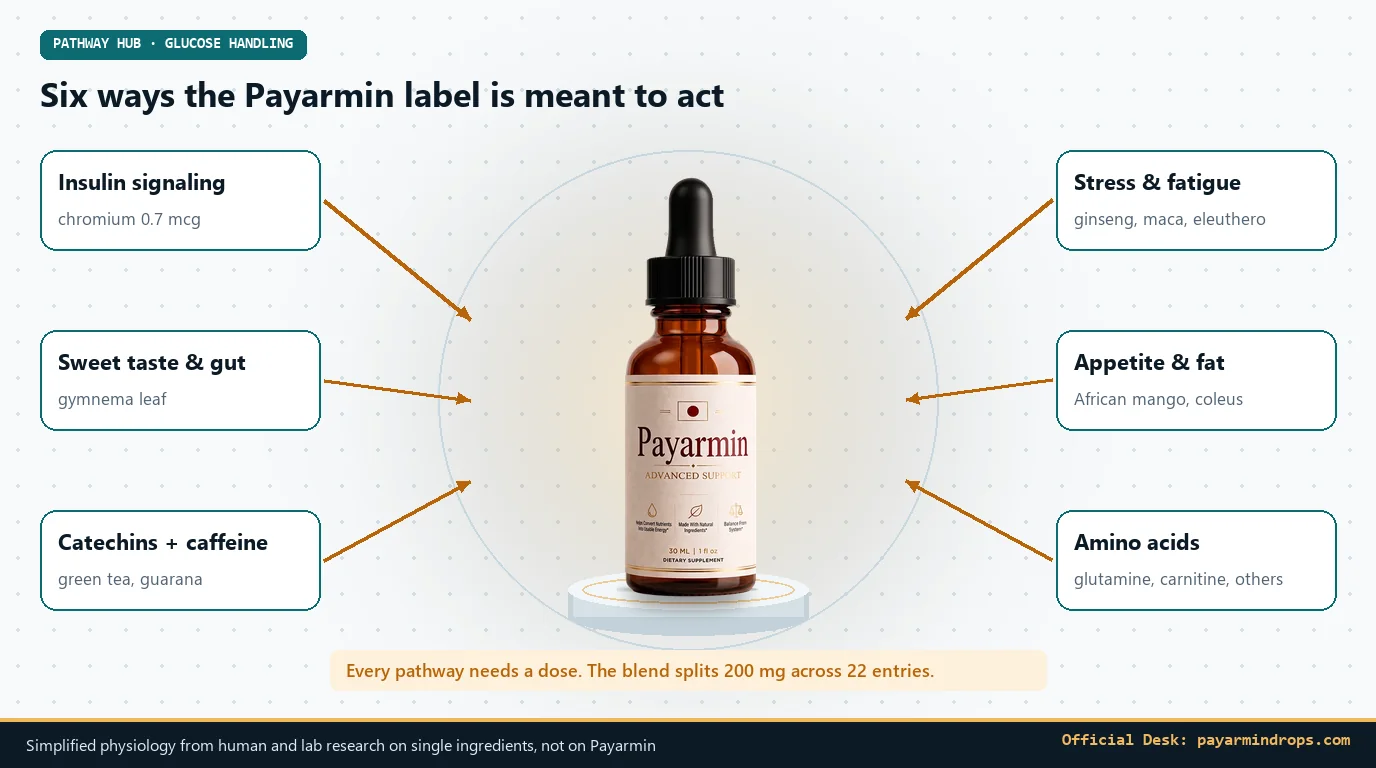
Any product claiming to "support healthy blood sugar" has to act on one of these steps: how fast sugar is absorbed, how well cells respond to insulin, how much glucose the liver releases, or how much and how fast people eat. Here is how each Payarmin ingredient is supposed to fit, and what dose it would need.
Pathway 1: insulin signaling (chromium)
Chromium is thought to work with a small peptide, sometimes called chromodulin, to amplify the insulin receptor's signal inside the cell. The clearest evidence is from deficiency: patients on long-term intravenous nutrition without chromium developed glucose intolerance that reversed with chromium[2]. In ordinary people, supplements at 200 to 1,000 mcg a day give small and inconsistent results[3].
At Payarmin's dose: 0.7 mcg is below what a slice of whole-wheat bread provides. This pathway is listed on the label but cannot be meaningfully engaged by one or two droppers.
Pathway 2: sweet taste and sugar absorption (gymnema)
Gymnemic acids have a structure similar to glucose. On the tongue they block sweet receptors for up to roughly an hour, which reduces the pleasure of sweet foods. Lab studies also suggest they may slow glucose uptake in the intestine, and animal studies have explored effects on the insulin-producing cells of the pancreas[4]. Human trials of extracts around 400 mg a day showed modest glucose improvements[5].
At Payarmin's dose: a liquid that touches the tongue can deliver the taste effect even at small amounts, so this is the most plausible pathway for this product: fewer sweet cravings for a short time after a dose. The intestinal and pancreatic effects need far more gymnema than a 200 mg blend can carry.
Pathway 3: catechins and caffeine (green tea, guarana)
Green tea catechins may slightly improve insulin sensitivity and reduce glucose absorption; caffeine increases alertness and energy use. Across 17 trials, green tea produced small reductions in fasting glucose[6]. Caffeine is double-edged: some studies show it briefly reduces insulin sensitivity after a meal, which is one reason people with diabetes are advised to watch their own response. The FDA's general ceiling for healthy adults is about 400 mg a day[7].
At Payarmin's dose: enough caffeine to be noticed by sensitive people, probably not enough to change glucose either way. The catechin dose is far below trial amounts.
Pathway 4: stress hormones and fatigue (ginseng, maca, eleuthero, astragalus)
The sales page argues that stress raises cortisol, which raises blood sugar, and that adaptogens blunt this. The first half is true: cortisol does raise glucose. The second half is speculative. Panax ginseng root lowered fasting glucose modestly in a meta-analysis[8]; maca's research is mostly about energy and libido[9]; astragalus and eleuthero have little human glucose data[10].
At Payarmin's dose: maca, the first-listed entry, may be the largest at perhaps tens of milligrams. Ginseng is an aerial (leaf and stem) extract listed twelfth. Real stress management, sleep and activity remain far stronger levers on cortisol and glucose.
Pathway 5: appetite and body weight (African mango, coleus, capsicum)
Weight loss improves insulin sensitivity, which is why weight-management ingredients show up in blood sugar products. African mango seed fiber may slow digestion and increase fullness; a branded extract reported large weight changes in a single group's trial[11], but a systematic review judged the evidence weak[12]. Forskolin shifted body composition slightly at 500 mg a day of a 10% extract[13]. Capsaicin modestly raises energy use.
At Payarmin's dose: no meaningful weight effect should be expected from milligram amounts.
Pathway 6: amino acids and the GLP-1 question
Some amino acids stimulate gut hormones. Glutamine is the best studied: 15 grams before a meal raised GLP-1 and lowered post-meal glucose a little in people with type 2 diabetes[14]. This is the thread some marketers pull when they hint at "natural GLP-1". The scale matters: 15 grams is 75 times Payarmin's entire 200 mg blend, and even 15 grams produced a fraction of the effect of a GLP-1 drug, which is engineered to resist breakdown for days[15].
At Payarmin's dose: trace amounts of eight amino acids, comparable to a bite of food.
Does stacking 23 small doses add up?
The formula's logic is that many modest effects combine. In pharmacology, synergy is real but has to be shown, usually by testing each component and the combination. Nobody has published such a test for Payarmin. With most ingredients at one-tenth to one-hundredth of their studied doses, the more realistic expectation is that the effects stay small, and the combined effect is unknown.
There is also a cost to long lists: more ingredients means more potential interactions (ginseng with warfarin, tryptophan with antidepressants, licorice with blood pressure) for a smaller benefit from each.
Evidence grades for each pathway
| Pathway | Key ingredient | Human evidence at studied dose | Plausible at Payarmin dose? |
|---|---|---|---|
| Insulin signaling | Chromium | Inconsistent, small | No (0.7 mcg) |
| Sweet taste | Gymnema | Consistent short-term taste effect | Possibly, briefly |
| Glucose absorption | Gymnema, green tea | Low-certainty, small | Unlikely |
| Stress and fatigue | Ginseng, maca | Modest for ginseng root | Unlikely |
| Weight and appetite | African mango, coleus | Weak, mixed | No |
| Gut hormones (GLP-1) | Glutamine | Small, at 15 g | No |
| Alertness | Guarana, green tea | Strong for caffeine | Mild, likely noticeable |
The levers that move blood sugar more
For comparison, here is what does shift glucose in trials. The Diabetes Prevention Program's lifestyle arm (about 7% weight loss and 150 minutes of activity a week) cut progression to diabetes by 58%[18]. A short walk right after meals lowered post-meal glucose more than the same walk at other times[16]. Diets higher in fiber and whole grains were linked to lower risk of type 2 diabetes in a large set of meta-analyses[17]. Prescription drugs, when needed, have outcome data that no supplement has.
If you try Payarmin, pair it with one of these, measure, and give credit where it is due. Know your targets: fasting glucose under 100 mg/dL is normal, 100 to 125 is prediabetes, 126 or more on repeat testing is diabetes[20]. Readings below 70 mg/dL are low and need attention[19].
Questions on this topic
How does Payarmin work in the body?
It is meant to act through several small pathways: chromium on insulin signaling, gymnema on sweet taste, green tea and guarana through catechins and caffeine, adaptogens on stress, and amino acids on gut hormones. At the label doses, only the taste and caffeine effects are plausible.
Does Payarmin really work?
There is no published trial of Payarmin. Some ingredients show modest effects at much larger doses. The fair test is your own fasting log over 30 to 60 days, compared with a baseline week.
Does Payarmin raise GLP-1?
Not in any meaningful way. Glutamine raised GLP-1 slightly in a study at 15 grams, about 75 times the whole Payarmin blend. GLP-1 drugs work at a completely different scale.
How fast does Payarmin act?
The caffeine can be felt within an hour, and gymnema's taste effect within minutes. Any change in fasting glucose, if it happens, would take weeks to show in averages.
Can Payarmin lower blood sugar too much?
On its own, unlikely at these doses. In combination with insulin or sulfonylureas, any added glucose-lowering effect raises the risk of lows, so talk to your prescriber first.
Is it better to hold Payarmin under the tongue?
The label says place in mouth and swallow. Holding it briefly may make the gymnema taste effect more noticeable, but true sublingual absorption of these ingredients is minimal.
Sources for this page
Each entry links to the original record. The studies tested single ingredients, usually at doses many times larger than a 200 mg blend can hold; none tested the Payarmin dropper itself.
- 1National Institute of Diabetes and Digestive and Kidney Diseases. Insulin Resistance & Prediabetes. www.niddk.nih.gov/health-information/diabetes/overview/what-is-diabetes/prediabetes-insulin-resistance
- 2NIH Office of Dietary Supplements. Chromium: Fact Sheet for Health Professionals. ods.od.nih.gov/factsheets/Chromium-HealthProfessional/
- 3Costello RB, Dwyer JT, Bailey RL. Chromium supplements for glycemic control in type 2 diabetes: limited evidence of effectiveness. Nutr Rev. 2016;74(7):455-468. pubmed.ncbi.nlm.nih.gov/27261273/
- 4Kanetkar P, Singhal R, Kamat M. Gymnema sylvestre: a memoir. J Clin Biochem Nutr. 2007;41(2):77-81. pubmed.ncbi.nlm.nih.gov/18193099/
- 5Devangan S, Varghese B, Johny E, et al. The effect of Gymnema sylvestre supplementation on glycemic control in type 2 diabetes patients: a systematic review and meta-analysis. Phytother Res. 2021;35(12):6802-6812. pubmed.ncbi.nlm.nih.gov/34467577/
- 6Liu K, Zhou R, Wang B, et al. Effect of green tea on glucose control and insulin sensitivity: a meta-analysis of 17 randomized controlled trials. Am J Clin Nutr. 2013;98(2):340-348. pubmed.ncbi.nlm.nih.gov/23803878/
- 7U.S. Food and Drug Administration. Spilling the Beans: How Much Caffeine Is Too Much? www.fda.gov/consumers/consumer-updates/spilling-beans-how-much-caffeine-too-much
- 8Shishtar E, Sievenpiper JL, Djedovic V, et al. The effect of ginseng (the genus Panax) on glycemic control: a systematic review and meta-analysis of randomized controlled clinical trials. PLoS One. 2014;9(9):e107391. pubmed.ncbi.nlm.nih.gov/25265315/
- 9Gonzales GF. Ethnobiology and ethnopharmacology of Lepidium meyenii (Maca), a plant from the Peruvian highlands. Evid Based Complement Alternat Med. 2012;2012:193496. pubmed.ncbi.nlm.nih.gov/21977053/
- 10National Center for Complementary and Integrative Health. Astragalus. www.nccih.nih.gov/health/astragalus
- 11Ngondi JL, Etoundi BC, Nyangono CB, Mbofung CM, Oben JE. IGOB131, a novel seed extract of the West African plant Irvingia gabonensis, significantly reduces body weight and improves metabolic parameters in overweight humans in a randomized double-blind placebo controlled investigation. Lipids Health Dis. 2009;8:7. pubmed.ncbi.nlm.nih.gov/19254366/
- 12Onakpoya I, Davies L, Posadzki P, Ernst E. The efficacy of Irvingia gabonensis supplementation in the management of overweight and obesity: a systematic review of randomized controlled trials. J Diet Suppl. 2013;10(1):29-38. pubmed.ncbi.nlm.nih.gov/23419021/
- 13Godard MP, Johnson BA, Richmond SR. Body composition and hormonal adaptations associated with forskolin consumption in overweight and obese men. Obes Res. 2005;13(8):1335-1343. pubmed.ncbi.nlm.nih.gov/16129715/
- 14Samocha-Bonet D, Wong O, Synnott EL, et al. Glutamine reduces postprandial glycemia and augments the glucagon-like peptide-1 response in type 2 diabetes patients. J Nutr. 2011;141(7):1233-1238. pubmed.ncbi.nlm.nih.gov/21593352/
- 15Drucker DJ. Mechanisms of action and therapeutic application of glucagon-like peptide-1. Cell Metab. 2018;27(4):740-756. pubmed.ncbi.nlm.nih.gov/29617641/
- 16Reynolds AN, Mann JI, Williams S, Venn BJ. Advice to walk after meals is more effective for lowering postprandial glycaemia in type 2 diabetes mellitus than advice that does not specify timing: a randomised crossover study. Diabetologia. 2016;59(12):2572-2578. pubmed.ncbi.nlm.nih.gov/27747394/
- 17Reynolds A, Mann J, Cummings J, et al. Carbohydrate quality and human health: a series of systematic reviews and meta-analyses. Lancet. 2019;393(10170):434-445. pubmed.ncbi.nlm.nih.gov/30638909/
- 18Knowler WC, Barrett-Connor E, Fowler SE, et al. Reduction in the incidence of type 2 diabetes with lifestyle intervention or metformin. N Engl J Med. 2002;346(6):393-403. pubmed.ncbi.nlm.nih.gov/11832527/
- 19National Institute of Diabetes and Digestive and Kidney Diseases. Low Blood Glucose (Hypoglycemia). www.niddk.nih.gov/health-information/diabetes/overview/preventing-problems/low-blood-glucose-hypoglycemia
- 20American Diabetes Association. Diagnosis: A1C, fasting plasma glucose and oral glucose tolerance test ranges. diabetes.org/about-diabetes/diagnosis
Ready for a fair 60-day Payarmin routine?
Orders finish on the maker's BuyGoods checkout. Log a week of fasting readings before the first dropper, and if nothing shifts, email the vendor before day 60: opened and empty bottles both qualify for the refund.