
Payarmin Ingredients: Every Label Entry, Milligram Breakdown & Research
Twenty-three entries, one itemized amount. Here is each ingredient in label order, what it is, what research tested and how much room it has inside a 200 mg blend.
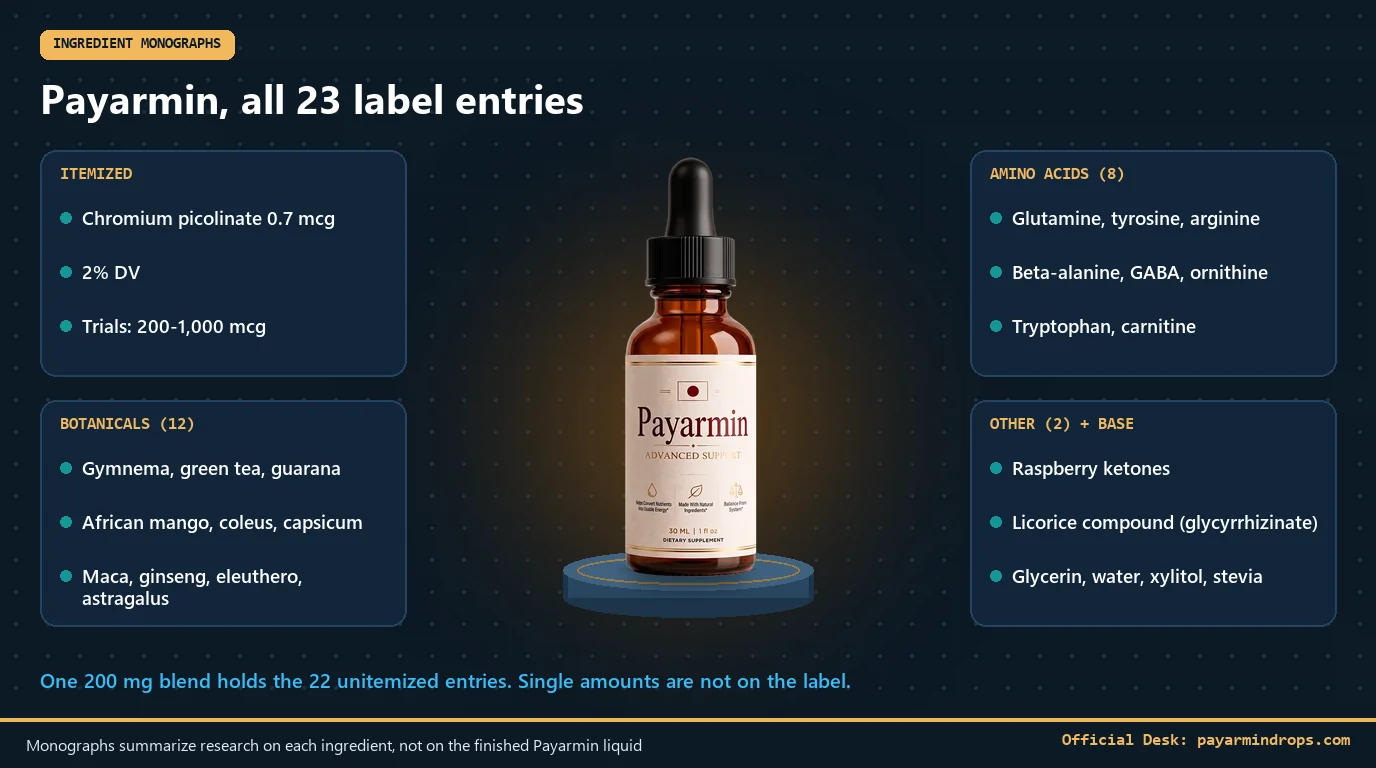
The full ingredient list, in label order
Payarmin's label lists 23 active entries. One is itemized: chromium, at 0.7 mcg per 1 mL serving. The other 22 sit in a single 200 mg proprietary blend, written in descending order by weight, which tells you their ranking but not their size. Below is every entry in the order the bottle prints it, grouped for reading, with what each is, what human research found and what that means for a product where the whole blend weighs 200 mg.
| # | Label entry | Type | Typical research dose |
|---|---|---|---|
| - | Chromium (as chromium picolinate) 0.7 mcg | Trace mineral | 200-1,000 mcg |
| 1 | Maca (Lepidium meyenii) Root Extract | Root | 1.5-3 g |
| 2 | Grape (Vitis vinifera) Seed Extract | Seed polyphenols | 150-300 mg |
| 3 | Guarana (Paullinia cupana) Seed Extract | Caffeine source | varies by caffeine |
| 4 | African Mango (Irvingia gabonensis) Seed Extract | Seed | 300 mg-3.15 g |
| 5 | Eleutherococcus Senticosus Root Extract | Root (adaptogen) | gram range |
| 6 | Astragalus Root Extract | Root | gram range |
| 7 | Green Tea (Camellia sinensis) Leaf Extract | Catechins + caffeine | hundreds of mg |
| 8 | Gymnema Leaf Extract | Leaf | ~400 mg |
| 9 | Coleus Forskohlii Root Extract | Root | 250 mg x2 (10%) |
| 10 | Capsicum Annuum Fruit Extract | Pepper fruit | mg of capsaicinoids |
| 11 | Grapefruit (Citrus paradisi) Fruit Extract | Citrus flavonoids | not established |
| 12 | Panax Ginseng Aerial Extract | Leaf and stem | 1-3 g (root) |
| 13 | Raspberry Ketones | Aroma compound | no human data |
| 14 | L-Glutamine | Amino acid | 5-15 g |
| 15 | L-Tyrosine | Amino acid | gram range |
| 16 | L-Arginine Base | Amino acid | 3-9 g |
| 17 | Beta-Alanine | Amino acid | 3.2-6.4 g |
| 18 | Monoammonium Glycyrrhizinate | Licorice compound | flavor use |
| 19 | GABA (Gamma amino butyric acid) | Neurotransmitter | 100-750 mg |
| 20 | L-Ornithine HCL | Amino acid | gram range |
| 21 | L-Tryptophan | Amino acid | 0.5-2 g |
| 22 | L-Carnitine Base | Amino-acid derivative | 1-3 g |
The right-hand column is the honest problem with this formula. Almost every entry is studied in hundreds of milligrams or grams. The whole blend is 200 mg per serving, 400 mg at the label maximum of two droppers, shared 22 ways.
Chromium picolinate: the only itemized active
Chromium (as chromium picolinate), 0.7 mcg
Essential trace mineral; picolinate is a well-absorbed salt
Chromium helps insulin pass its signal into cells. A genuine deficiency, mainly seen in people fed intravenously for long periods, causes glucose intolerance that reverses when chromium is replaced. Normal diets supply it through whole grains, broccoli, potatoes, meat and some spices[1].
The research: Results in people who are not deficient are inconsistent. A review in Nutrition Reviews concluded the evidence for glycemic control in type 2 diabetes is limited[2]; a meta-analysis found small falls in fasting glucose in some subgroups, at 200 to 1,000 mcg a day[3]. In overweight adults, weight changed by about half a kilogram versus placebo[4].
In Payarmin: 0.7 mcg per serving is 2% of the 35 mcg Daily Value and between 1/300 and 1/1,400 of trial doses. It will not change your chromium status in any meaningful way.
Gymnema: sweet taste and post-meal glucose
Gymnema Leaf Extract
Gymnema sylvestre, a woody climber from India and Africa
The leaves contain gymnemic acids, which temporarily occupy sweet-taste receptors so that sugar tastes flat for up to about an hour. Traditional Ayurvedic use for "madhumeha", sweet urine, gave it the name gurmar[5].
The research: The classic trial gave 400 mg a day of a specific extract to 22 people with type 2 diabetes for 18 to 20 months, alongside their medicine, and reported lower glucose and A1C[6]. A 2021 meta-analysis found lower fasting glucose, post-meal glucose and A1C, with low-certainty evidence from small studies[7].
In Payarmin: Listed eighth of 22. Its amount is unknown but far below 400 mg. In a liquid that touches the tongue, the brief sweet-blocking effect is the most realistic benefit, for example before a dessert you want to skip.
Green tea and guarana: catechins and caffeine
Green Tea (Camellia sinensis) Leaf Extract + Guarana (Paullinia cupana) Seed Extract
Two caffeine-bearing plants; green tea adds catechins such as EGCG
Green tea catechins are antioxidants studied for metabolism and weight. Guarana seeds hold roughly twice the caffeine of coffee beans by weight. Together they make Payarmin a mildly "stimulating" product, the word the maker's own FAQ uses.
The research: A meta-analysis of 17 trials found green tea lowered fasting glucose and A1C slightly, without clear changes in insulin[8]. Concentrated green tea extracts are a recognized, rare cause of liver injury[9]; a United States Pharmacopeia review tied the risk to high EGCG doses, especially taken fasting[10]. The FDA treats about 400 mg of caffeine a day as an amount not generally linked to problems in healthy adults[11].
In Payarmin: Guarana is third and green tea seventh. With 200 mg of blend shared 22 ways, the caffeine is likely a few milligrams to perhaps a couple of dozen, but the label does not say. Caffeine-sensitive readers should take it early in the day.
African mango, coleus, capsicum and raspberry ketones
African Mango (Irvingia gabonensis) Seed, Coleus Forskohlii Root, Capsicum Annuum Fruit, Raspberry Ketones
The weight-management cluster
These four appear in many weight products. African mango seed is rich in soluble fiber; coleus supplies forskolin, which raises cellular cAMP; capsicum supplies capsaicin, which causes mild heat and a small rise in energy use; raspberry ketone is an aroma compound.
The research: African mango results come mainly from one research group in Cameroon: weight and glucose changes at 3.15 g of seed[12] and at 150 mg twice daily of a branded extract[13]. A systematic review called the trials small and poorly reported[14]. Forskolin was studied at 250 mg of a 10% extract twice a day, with changes in body composition but not weight[15]. Raspberry ketone has essentially no human trial data on its own.
In Payarmin: African mango is fourth, coleus ninth, capsicum tenth, raspberry ketones thirteenth. None can approach the doses studied.
Ginseng, eleuthero, astragalus and maca
Panax Ginseng Aerial Extract, Eleutherococcus Senticosus Root, Astragalus Root, Maca (Lepidium meyenii) Root
The adaptogen cluster
Adaptogens are plants said to improve resistance to stress and fatigue. Maca is a Peruvian root vegetable used for energy and libido[19]; astragalus is a staple of traditional Chinese medicine[20]; eleuthero is often called Siberian ginseng, though it is a different genus.
The research: Panax ginseng has the most glucose research: a meta-analysis found a modest fall in fasting glucose, usually from 1 to 3 g a day of root[16], and the NCCIH summary calls evidence for most uses limited[17]. In a controlled trial, American ginseng weakened warfarin's effect[18]. Maca studies use 1.5 to 3 g a day.
In Payarmin: Maca is listed first, so it is likely the largest entry, perhaps tens of milligrams. Note that the label lists ginseng aerial extract, leaves and stems, while most glucose trials used the root, and the sales page calls it a root.
Grape seed and grapefruit
Grape (Vitis vinifera) Seed Extract, Grapefruit (Citrus paradisi) Fruit Extract
Polyphenol-rich fruit extracts
Grape seed extract is concentrated proanthocyanidins. Grapefruit fruit extract carries flavonoids such as naringin and, depending on the part used, furanocoumarins, the compounds behind grapefruit's drug interactions.
The research: A meta-analysis of grape seed extract found a small blood pressure drop and no clear effect on lipids or glucose[23]. Grapefruit juice blocks the CYP3A4 enzyme in the gut and can raise blood levels of statins, some calcium channel blockers and other drugs[24][25].
In Payarmin: Grape seed is second on the list, so possibly a meaningful share of the blend. The grapefruit amount is unknown and likely tiny; still, people on CYP3A4-sensitive drugs should mention it to a pharmacist.
The eight amino acids
L-Glutamine, L-Tyrosine, L-Arginine Base, Beta-Alanine, GABA, L-Ornithine HCL, L-Tryptophan, L-Carnitine Base
Amino acids and close relatives
These are building blocks or messengers the body already makes or gets from protein foods. Each has a separate story: glutamine for the gut and GLP-1, tyrosine for alertness, arginine for nitric oxide, beta-alanine for muscle buffering, GABA for calm, ornithine for ammonia handling, tryptophan for serotonin and carnitine for fat transport into mitochondria.
The research: Glutamine at 15 g raised GLP-1 and lowered post-meal glucose a little in type 2 diabetes[26]. Beta-alanine is studied at 3.2 to 6.4 g a day for high-intensity exercise[27]. The others are also gram-dose ingredients in research.
In Payarmin: Positions 14 to 22, the lighter half of a 200 mg blend. A single egg supplies hundreds of milligrams of most of these amino acids. Tryptophan, though small, is worth mentioning to anyone on an antidepressant.
Monoammonium glycyrrhizinate (licorice)
Monoammonium Glycyrrhizinate
Ammonium salt of glycyrrhizin, the sweet compound in licorice root
Glycyrrhizin is about 50 times sweeter than sugar and is used mainly as a sweetener and flavor masker, which is likely its role in a bitter herbal liquid.
The research: Regular, larger intakes of licorice raise blood pressure and lower potassium by blocking an enzyme that protects the kidney's mineral balance[22][21].
In Payarmin: Eighteenth of 22, so very likely a few milligrams or less. Still, people with high blood pressure, heart or kidney disease, or on diuretics should be aware it is there.
The liquid base: glycerin, sweeteners, preservatives
The "other ingredients" line reads: glycerin, water, organic lemon extract, stevia extract 97% (Reb A), xylitol, sodium benzoate, potassium sorbate, citric acid and natural flavors. Glycerin is a sweet, thick solvent that carries plant extracts; stevia and xylitol add sweetness without much sugar; sodium benzoate and potassium sorbate prevent mold and bacteria once the bottle is opened; citric acid adjusts acidity.
Two points matter. Xylitol is safe for people in these amounts, but it is highly toxic to dogs, even in small quantities, so store the bottle where a pet cannot chew it. And glycerin, stevia and xylitol barely affect blood sugar at 1 to 2 mL, so the base itself will not spoil a glucose reading.
What the ingredient list adds up to
Read on its own, the list looks like a well-stocked metabolic formula: chromium, gymnema, green tea, ginseng, African mango, adaptogens and amino acids. Read with the amounts, it is a trace of chromium and a small spoon of many things. The ingredients with the best glucose evidence (chromium, gymnema, ginseng) are all present at doses far below what was studied.
That does not make Payarmin harmful, and the label is more complete than many. It does mean the honest expectation is "a light botanical routine", and that anyone serious about their numbers should judge it with a meter and keep the refund deadline in mind.
Questions on this topic
Which Payarmin ingredient is the strongest?
None stands out at these doses. The ingredients with the best glucose evidence are chromium, gymnema and Panax ginseng, but each is far below its studied amount. Maca is listed first, so it is probably the largest entry in the blend.
Does Payarmin contain caffeine?
Yes, from guarana seed and green tea leaf. The label does not state an amount. Within a 200 mg blend shared by 22 entries it is probably small, but caffeine-sensitive people should take it in the morning.
Is Payarmin vegan and gluten-free?
The label lists no animal-derived ingredients and no gluten grains, but it makes no vegan, gluten-free or allergen claims. Ask the vendor if you need confirmation.
Why does the sales page show only six ingredients?
It features chromium, gymnema, African mango, green tea, maca and Panax ginseng with photographs. The bottle lists all 23 entries. The panel is the authoritative source.
Is the ginseng in Payarmin a root extract?
No. The label says Panax Ginseng Aerial Extract, meaning leaves and stems. Most glucose studies used the root, although the sales page describes it as a root.
Is xylitol in Payarmin safe?
For people, yes, in these amounts. For dogs, no: xylitol can cause severe low blood sugar and liver failure in dogs. Keep the bottle out of their reach.
Sources for this page
Each entry links to the original record. The studies tested single ingredients, usually at doses many times larger than a 200 mg blend can hold; none tested the Payarmin dropper itself.
- 1NIH Office of Dietary Supplements. Chromium: Fact Sheet for Health Professionals. ods.od.nih.gov/factsheets/Chromium-HealthProfessional/
- 2Costello RB, Dwyer JT, Bailey RL. Chromium supplements for glycemic control in type 2 diabetes: limited evidence of effectiveness. Nutr Rev. 2016;74(7):455-468. pubmed.ncbi.nlm.nih.gov/27261273/
- 3Suksomboon N, Poolsup N, Yuwanakorn A. Systematic review and meta-analysis of the efficacy and safety of chromium supplementation in diabetes. J Clin Pharm Ther. 2014;39(3):292-306. pubmed.ncbi.nlm.nih.gov/24635480/
- 4Onakpoya I, Posadzki P, Ernst E. Chromium supplementation in overweight and obesity: a systematic review and meta-analysis of randomized clinical trials. Obes Rev. 2013;14(6):496-507. pubmed.ncbi.nlm.nih.gov/23495911/
- 5Kanetkar P, Singhal R, Kamat M. Gymnema sylvestre: a memoir. J Clin Biochem Nutr. 2007;41(2):77-81. pubmed.ncbi.nlm.nih.gov/18193099/
- 6Baskaran K, Kizar Ahamath B, Radha Shanmugasundaram K, Shanmugasundaram ER. Antidiabetic effect of a leaf extract from Gymnema sylvestre in non-insulin-dependent diabetes mellitus patients. J Ethnopharmacol. 1990;30(3):295-300. pubmed.ncbi.nlm.nih.gov/2259217/
- 7Devangan S, Varghese B, Johny E, et al. The effect of Gymnema sylvestre supplementation on glycemic control in type 2 diabetes patients: a systematic review and meta-analysis. Phytother Res. 2021;35(12):6802-6812. pubmed.ncbi.nlm.nih.gov/34467577/
- 8Liu K, Zhou R, Wang B, et al. Effect of green tea on glucose control and insulin sensitivity: a meta-analysis of 17 randomized controlled trials. Am J Clin Nutr. 2013;98(2):340-348. pubmed.ncbi.nlm.nih.gov/23803878/
- 9LiverTox: Clinical and Research Information on Drug-Induced Liver Injury. Green Tea. National Institute of Diabetes and Digestive and Kidney Diseases. www.ncbi.nlm.nih.gov/books/NBK547925/
- 10Oketch-Rabah HA, Roe AL, Rider CV, et al. United States Pharmacopeia (USP) comprehensive review of the hepatotoxicity of green tea extracts. Toxicol Rep. 2020;7:386-402. pubmed.ncbi.nlm.nih.gov/32140423/
- 11U.S. Food and Drug Administration. Spilling the Beans: How Much Caffeine Is Too Much? www.fda.gov/consumers/consumer-updates/spilling-beans-how-much-caffeine-too-much
- 12Ngondi JL, Oben JE, Minka SR. The effect of Irvingia gabonensis seeds on body weight and blood lipids of obese subjects in Cameroon. Lipids Health Dis. 2005;4:12. pubmed.ncbi.nlm.nih.gov/15916709/
- 13Ngondi JL, Etoundi BC, Nyangono CB, Mbofung CM, Oben JE. IGOB131, a novel seed extract of the West African plant Irvingia gabonensis, significantly reduces body weight and improves metabolic parameters in overweight humans in a randomized double-blind placebo controlled investigation. Lipids Health Dis. 2009;8:7. pubmed.ncbi.nlm.nih.gov/19254366/
- 14Onakpoya I, Davies L, Posadzki P, Ernst E. The efficacy of Irvingia gabonensis supplementation in the management of overweight and obesity: a systematic review of randomized controlled trials. J Diet Suppl. 2013;10(1):29-38. pubmed.ncbi.nlm.nih.gov/23419021/
- 15Godard MP, Johnson BA, Richmond SR. Body composition and hormonal adaptations associated with forskolin consumption in overweight and obese men. Obes Res. 2005;13(8):1335-1343. pubmed.ncbi.nlm.nih.gov/16129715/
- 16Shishtar E, Sievenpiper JL, Djedovic V, et al. The effect of ginseng (the genus Panax) on glycemic control: a systematic review and meta-analysis of randomized controlled clinical trials. PLoS One. 2014;9(9):e107391. pubmed.ncbi.nlm.nih.gov/25265315/
- 17National Center for Complementary and Integrative Health. Asian Ginseng. www.nccih.nih.gov/health/asian-ginseng
- 18Yuan CS, Wei G, Dey L, et al. Brief communication: American ginseng reduces warfarin's effect in healthy patients: a randomized, controlled trial. Ann Intern Med. 2004;141(1):23-27. pubmed.ncbi.nlm.nih.gov/15238367/
- 19Gonzales GF. Ethnobiology and ethnopharmacology of Lepidium meyenii (Maca), a plant from the Peruvian highlands. Evid Based Complement Alternat Med. 2012;2012:193496. pubmed.ncbi.nlm.nih.gov/21977053/
- 20National Center for Complementary and Integrative Health. Astragalus. www.nccih.nih.gov/health/astragalus
- 21National Center for Complementary and Integrative Health. Licorice Root. www.nccih.nih.gov/health/licorice-root
- 22Penninkilampi R, Eslick EM, Eslick GD. The association between consistent licorice ingestion, hypertension and hypokalaemia: a systematic review and meta-analysis. J Hum Hypertens. 2017;31(11):699-707. pubmed.ncbi.nlm.nih.gov/28660884/
- 23Feringa HH, Laskey DA, Dickson JE, Coleman CI. The effect of grape seed extract on cardiovascular risk markers: a meta-analysis of randomized controlled trials. J Am Diet Assoc. 2011;111(8):1173-1181. pubmed.ncbi.nlm.nih.gov/21802563/
- 24Bailey DG, Dresser G, Arnold JM. Grapefruit-medication interactions: forbidden fruit or avoidable consequences? CMAJ. 2013;185(4):309-316. pubmed.ncbi.nlm.nih.gov/23184849/
- 25U.S. Food and Drug Administration. Grapefruit Juice and Some Drugs Don't Mix. www.fda.gov/consumers/consumer-updates/grapefruit-juice-and-some-drugs-dont-mix
- 26Samocha-Bonet D, Wong O, Synnott EL, et al. Glutamine reduces postprandial glycemia and augments the glucagon-like peptide-1 response in type 2 diabetes patients. J Nutr. 2011;141(7):1233-1238. pubmed.ncbi.nlm.nih.gov/21593352/
- 27Trexler ET, Smith-Ryan AE, Stout JR, et al. International Society of Sports Nutrition position stand: beta-alanine. J Int Soc Sports Nutr. 2015;12:30. pubmed.ncbi.nlm.nih.gov/26175657/
Ready for a fair 60-day Payarmin routine?
Orders finish on the maker's BuyGoods checkout. Log a week of fasting readings before the first dropper, and if nothing shifts, email the vendor before day 60: opened and empty bottles both qualify for the refund.